Riley Hughes · 14 September 2026
Navigating Infrastructure Overhauls in Subscription Web Platforms
Subscription web platforms handle recurring billing cycles, user data management, and content delivery at scale, which creates ongoing pressure to refresh underlying infrastructure as traffic grows and security requirements tighten. Companies that offer software as a service often reach points where legacy systems cannot support new features or meet updated compliance standards, prompting structured overhaul projects that span multiple quarters.
Drivers Behind Infrastructure Changes
Data from industry reports shows that subscription platforms experience traffic spikes of 40 percent or more during renewal periods, forcing teams to address capacity limits before outages affect revenue streams. Researchers at academic institutions have documented how older database architectures struggle with the volume of real-time payment processing that modern platforms require, leading organizations to migrate toward distributed systems that handle concurrent transactions more efficiently. In September 2026 several large providers plan to complete phased migrations to cloud environments that incorporate automated scaling rules, a timeline driven by both internal growth targets and external regulatory updates on data residency.
Strategic Planning Approaches
Teams begin by mapping current dependencies across billing engines, authentication layers, and content delivery networks, which allows them to identify single points of failure that could disrupt subscriber access during transition windows. Observers note that successful projects allocate dedicated testing environments that mirror production traffic patterns, enabling engineers to validate new configurations without exposing live user accounts to risk. Government sources in Canada have published guidance on digital service continuity that recommends maintaining parallel systems until migration checkpoints confirm stability across all modules.
Resource allocation follows a staged model where infrastructure teams coordinate with product groups to prioritize features that depend on the new architecture, ensuring that subscription management tools remain operational throughout the process. Figures from cloud service providers indicate that platforms adopting container orchestration during overhauls reduce deployment times by an average of 35 percent compared with traditional virtual machine setups.
Implementation Steps and Monitoring
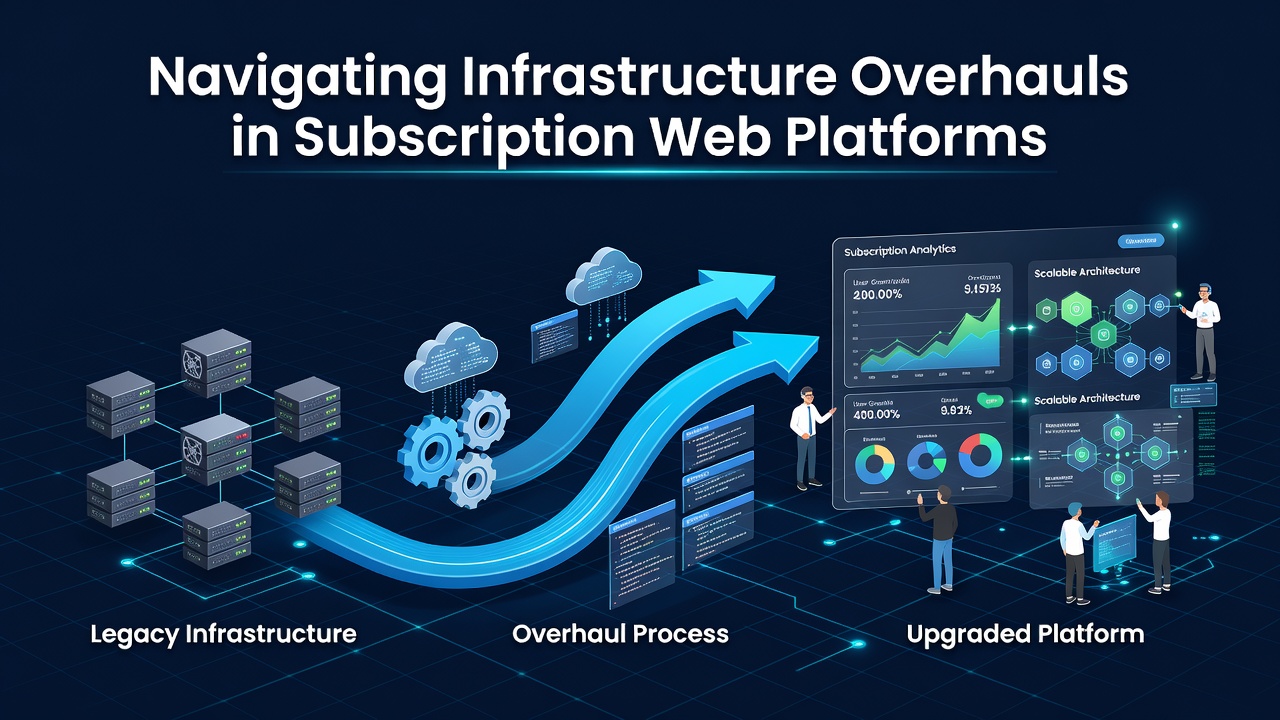
Execution typically starts with non-critical services such as analytics dashboards before moving to core billing components, which minimizes the chance of revenue interruption. Engineers use blue-green deployment techniques that allow instant rollback if performance metrics deviate from established baselines, a method documented in technical papers from research universities across Europe. Continuous monitoring tools track latency, error rates, and database query performance in real time, giving teams immediate visibility into any degradation that occurs during data synchronization phases.

Addressing Common Technical Hurdles
Data migration presents one of the most persistent challenges because subscription records contain sensitive payment histories that must remain consistent across old and new storage layers. Specialists apply checksum verification and incremental sync processes to confirm that every transaction record transfers without alteration, reducing the likelihood of billing discrepancies after cutover. Network latency between regions can also surface when platforms expand to new geographic markets, prompting architects to implement edge caching layers that shorten response times for subscribers located far from primary data centers.
Security audits conducted midway through overhauls often reveal configuration drift that developed during rapid scaling phases, requiring remediation before final go-live dates. Reports from the Australian Cyber Security Centre emphasize the value of embedding encryption key rotation schedules into the new infrastructure from the outset rather than retrofitting them later.
Post-Overhaul Optimization
Once the core systems stabilize, teams shift focus to performance tuning that leverages new hardware capabilities, such as faster solid-state storage and improved network interfaces. Metrics collected after migration show sustained improvements in page load speeds and reduced infrastructure costs per active subscriber when automation replaces manual scaling tasks. Organizations that publish transparency reports on these projects note that subscriber retention rates remain stable when communication about maintenance windows occurs well in advance.
Conclusion
Infrastructure overhauls in subscription web platforms follow predictable patterns of assessment, phased migration, and post-implementation review, with timelines increasingly aligned to external regulatory milestones such as those scheduled for September 2026. Data from multiple regions demonstrates that structured planning and rigorous testing correlate with fewer service disruptions and more predictable operational costs over the long term. Platforms that integrate monitoring early and maintain rollback options throughout the process position themselves to absorb future growth without repeating full-scale rebuilds.